
PRODUCT
PRODUCT
CONTACT US
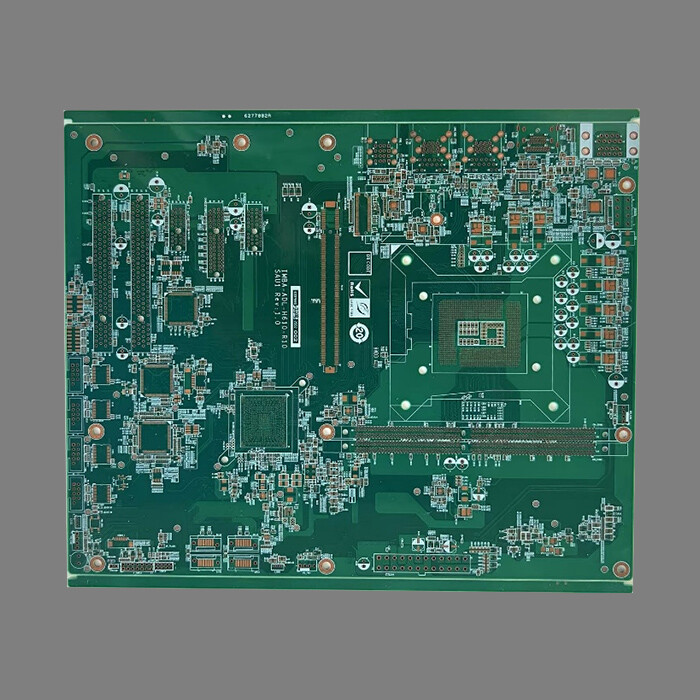
Key Parameters of Industrial Computer PCB
Commodity Name: Industrial Computer Printed Circuit Board
Brand Name: HFast
Layers: 6L
Board Thickness: 1.60mm
Minimum Hole Size: 0.20mm
Minimum Line Width: 0.10mm
Minimum Line Spacing: 0.10mm
Color: Green Oil and White Legend
Surface Treatment: Gold Plating
Characteristics of different types of Industrial Computer PWB
1. Desktop motherboard:
*Size standardization: ATX, Micro ATX, Mini ITX, etc.
*Strong scalability: Provides multiple PCIe and memory slots.
*High power demand: Supports high-performance CPUs and independent graphics cards.
*The heat dissipation space is relatively abundant.
1. Laptop motherboard:
Extremely compact:Space is the primary constraint, and the number of layers may be higher to save area.
*Highly integrated: CPU, GPU (possibly integrated), chipset, memory (possibly onboard), and some interface controllers are highly integrated.
Rigid flexible combination board:may be used to connect screens, cameras, and other parts that require movement or limited space.
Heat dissipation design is extremely important:Small space, high heat density.
*Strict power consumption control: The requirements for VRM efficiency and heat dissipation are extremely high.
3. Server/Workstation Motherboard:
Extra Large Size:Supports multiple CPU sockets, massive memory (more DIMM slots), and extensive PCIe expansion.
Ultimate stability and reliability:Made of top-notch materials, designed with redundancy (such as dual network cards and management ports), supporting ECC memory.
Extremely powerful power supply: Provides power to multiple high-power CPUs.
High speed interconnection:Supports more high-speed network interfaces (10 Gigabit/higher speed) and NVMe storage.
Powerful management function: Integrated BMC (baseboard management controller).
Design and Manufacturing Challenges of Industrial Computer PCB
1.Design complexity: Requires proficiency in high-speed digital design, power design, EMC design, thermal design, DFM (design for manufacturability).
2. Simulation driver: heavily relies on SI (signal integrity), PI (power integrity), and EMI simulation tools for preliminary verification.
3. Material cost:High performance substrates, thick copper, and high-rise digital displays increase costs.
4. Manufacturing accuracy: The requirements for interlayer alignment, line width and spacing control, drilling accuracy (especially laser drilling micro holes), and electroplating uniformity are extremely high.
5. Quality control: 100% electrical testing (flying needle/needle bed), AOI (automatic optical inspection), and X-Ray testing (BGA soldering) are essential.
Online Message
Application

CONTACT US
Please use the form below to get in touch.
If you need a reply we will get in touch as soon as possible.