
PRODUCT
PRODUCT
CONTACT US
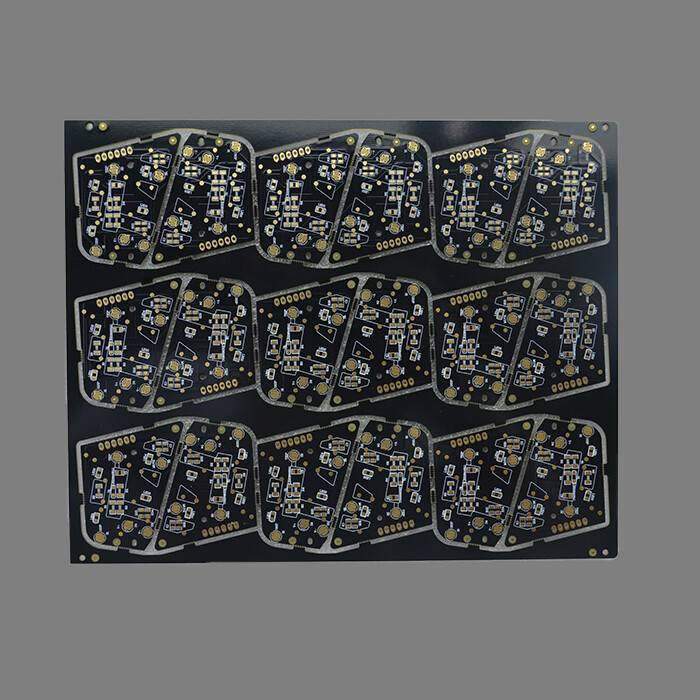
Key Parameters of Wiper Motor PCB
Commodity Name: Automotive switch PCB board
Brand Name: HFast
Layers: 2L
Board Thickness: 1.60mm
Minimum Hole Size: 0.25mm
Minimum Line Width: 0.20mm
Minimum Line Spacing: 0.20mm
Surface Treatment: Gold Plating
Color: Black Oil and White Legend
Simple Introduction of Automotive PCB
Automotive PCB( also called vehicle PCB or Car PCB) is a printed circuit board specifically designed and manufactured for automotive applications. It is a massive and crucial component of modern automobiles, serving as the "nervous system" and "physical carrier" for various electronic control units (ECUs), sensors, actuators, and entertainment systems.
Simply put, it is a substrate that connects and fixes electronic components (chips, resistors, capacitors, connectors, etc.) according to a specific circuit design. Without high-quality and highly reliable PCBs, complex electronic functions in cars cannot be achieved.
Key technical characteristics of Automotive PCB
1. Material selection:
Substrate:
*High temperature FR-4: It is the most commonly used, cost-effective, and suitable for most non extreme high temperature areas (such as vehicle control and information entertainment). There are different grades (Tg value glass transition temperature, such as Tg 150 ° C, Tg 170 ° C).
*Polyimide: Excellent high temperature resistance (Tg>250 ° C), good flexibility, commonly used in high-temperature areas of engine compartments or flexible boards.
*Ceramic substrate: Excellent thermal conductivity, used for modules with high power and high heat dissipation requirements (such as IGBT drivers and LED headlights).
*High frequency materials: such as Rogers series, used for high-frequency applications such as radar and V2X communication.
*Metal substrate: such as aluminum substrate, mainly used for high-power LED headlights, with excellent heat dissipation.
*Copper foil: Thickness selection (usually starting from 1oz, power part may be above 2oz), low roughness copper foil (used for high-frequency signals).
*Solder mask: High heat resistance, high adhesion, excellent chemical resistance, and electrical performance are required. The color is mostly green, but there are also black, white, and so on.
*Surface treatment:
*Nickel immersion gold: The most commonly used, with good flatness and weldability, suitable for fine spacing components, and good corrosion resistance.
Silver deposition: Low cost, good weldability, but prone to sulfurization and blackening (requiring special storage or coating protection).
Sinking tin: Good solderability, low cost, but tin risk (can be mitigated through process control).
*OSP: The lowest cost, protects the copper surface from oxidation, but has a short solderability shelf life and limited welding times. Less commonly used in automobiles.
Tin spraying: Moderate cost, good solderability, but poor flatness, not suitable for fine pitch components. Gradually being replaced.
2.Layers and structural design of automotive PCB
*Select the number of layers based on the complexity of the circuit.
*Carefully designed power and ground layers (essential for multi-layer boards), providing low impedance circuits, reducing noise, and shielding interference.
*The high-speed signal layer is usually sandwiched between the power supply/ground layer (stripline structure) to control impedance and reduce crosstalk.
3.Special Process of Vehicle PCB
*Thick copper: Used for high current paths.
Buried resistance/capacitance: Integrate resistance or capacitance components inside the PCB to save surface space, improve reliability (reduce solder joints), and enhance high-frequency performance. The cost is relatively high.
Rigid flexible combination board: Integrating rigid and flexible boards together, used in places with limited space or requiring movable connections (such as camera modules, folding screen instrument panels).
*High thermal conductivity design: Use thermal conductivity holes, metal inserts, and other methods to quickly dissipate the heat from key heating elements to the heat sink.
Online Message
Application


CONTACT US
Please use the form below to get in touch.
If you need a reply we will get in touch as soon as possible.