
PRODUCT
PRODUCT
CONTACT US
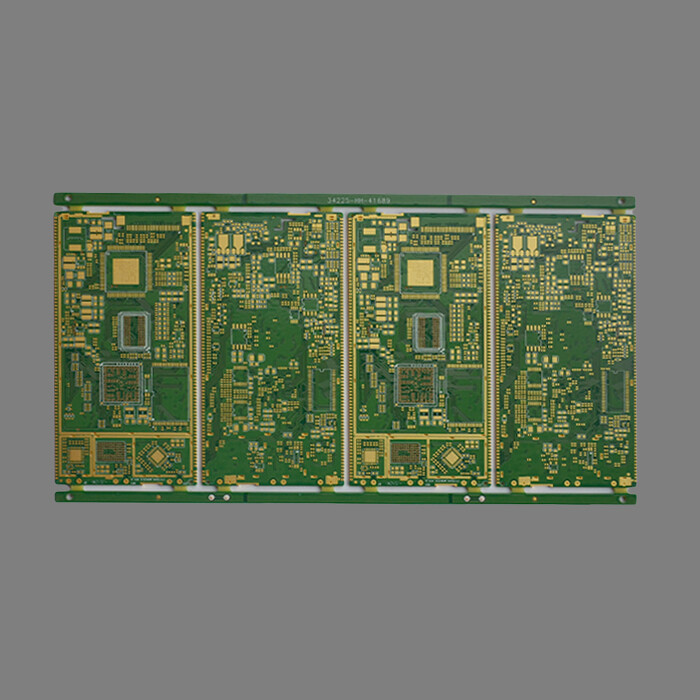
Key Parameters of GPS Module PCB
Commodity Name: Vehicle GPS Module PCB
Brand Name: HFast
Layers: 4L
Board Thickness: 1.00mm
Minimum Hole Size: 0.20mm
Minimum Line Width: 0.076mm
Minimum Line Spacing: 0.076mm
Color: Green Oil and White Legend
Surface: Gold Plating
Challenges and Development Trends Faced by Automotive Electronic PCB
1.Challenge:
*Meet increasingly stringent environmental and reliability requirements, especially in high-pressure and high-temperature environments for electric vehicles.
*Dealing with signal integrity and power integrity challenges brought by high-speed and high-density design.
*Control costs, especially in the case of large-scale adoption of new technologies such as HDI and high-frequency materials.
*Supply chain security and stability.
*Meet the requirements of functional safety standards such as ISO 26262.
2.Development Trends:
Higher density interconnection: More layers, thinner line width/spacing, smaller via holes (mSAP process).
*High frequency and high-speed: To meet the demands of 5G V2X, millimeter wave radar, and high-speed Ethernet, higher requirements are placed on materials and design.
*Integration and modularization: Domain controllers and central computing platforms integrate multiple functions, requiring PCBs to carry more functions and higher power density.
*Upgraded heat dissipation technology: With the application of power devices (SiC, GaN) and the improvement of computing power, efficient heat dissipation solutions (such as IMS, heat pipe integration) are becoming increasingly important.
*New material applications: Higher performance substrates (lower losses, higher thermal conductivity), new surface treatments.
*The application of rigid flexible combination board has increased: it adapts to more compact and flexible installation requirements.
*Intelligent design and simulation tools: Utilizing AI/ML to optimize design, improve simulation accuracy and efficiency.
*Sustainability: Exploring more environmentally friendly materials and manufacturing processes.
Online Message
Application


CONTACT US
Please use the form below to get in touch.
If you need a reply we will get in touch as soon as possible.